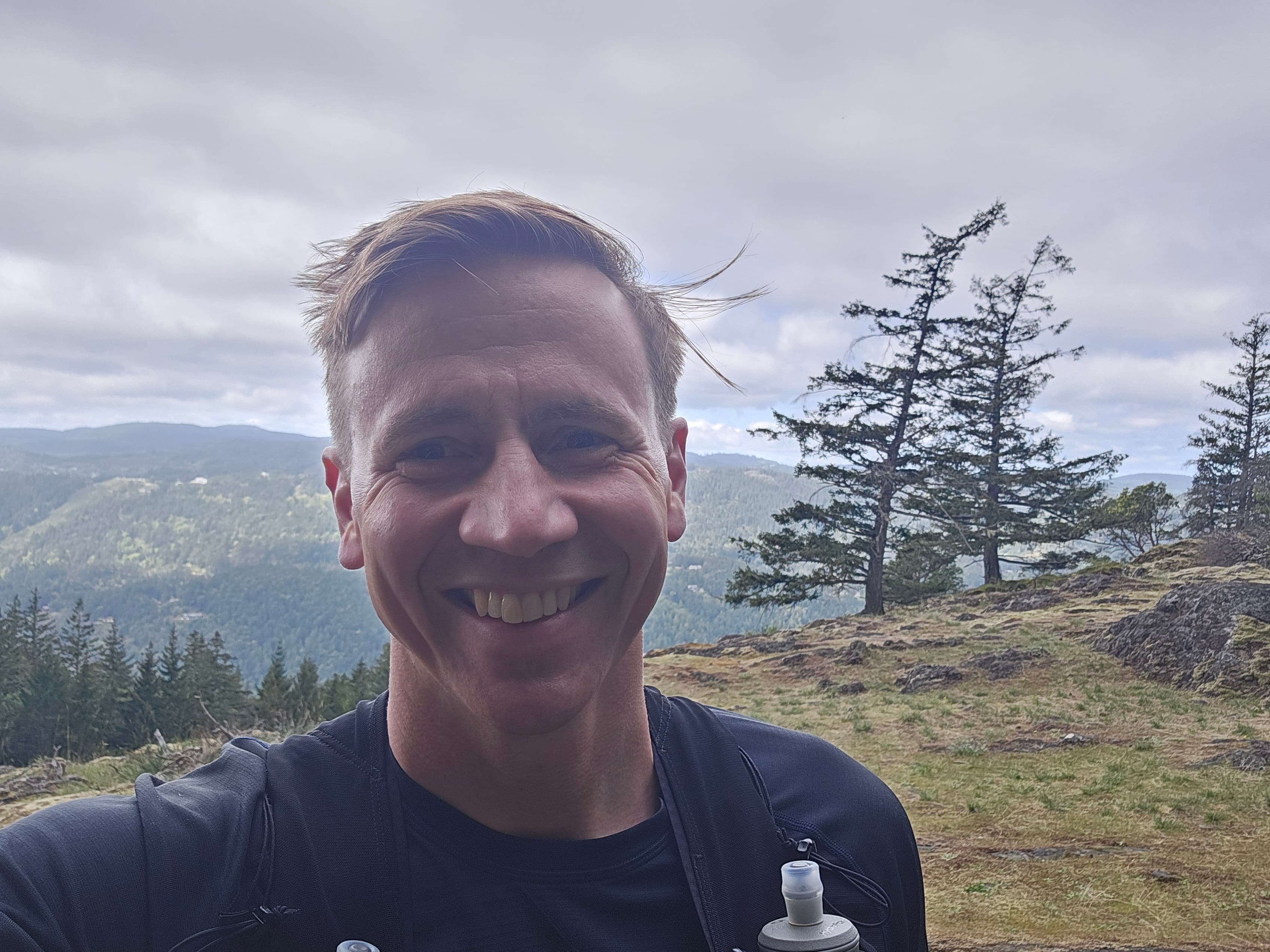
Near the end of my undergraduate degree I had three options in front of me. Option one: a friend was planning to spend close to a year touring Peru, climbing in the Andes, and I was going to go explore South America with him. Option two: I'd met somebody looking for a safety boater for rafting trips in Nepal. He said the money would be terrible, but I wouldn't have to wear shoes, there was pretty much all the beer I could drink, and I'd spend my days picking kids from the international school out of the river and getting them to shore. Option three, the one I took, was a computer programming program at a very sketchy private college. I can't even remember what it was called. But it taught me how to program. I'd read Douglas Coupland's Microserfs and it made me want to be a computer programmer. I thought the culture and the lifestyle sounded cool, and this was right when the dot-com era was taking off.
My first professional work, in 1998, was network installs. With no real credentials except barely a credential in computer programming, I called a number of firms hoping somebody would go for lunch with me and tell me what their business was about and how a person got involved in it. Web Tactics, a dot-com consulting agency in Guelph focused on the agricultural space but with a lot of different clients, was growing like crazy. They hired me in 1999. I took on a number of leadership roles and became one of their lead developers. Claudia Schiffer and the Canadian children's author Robert Munsch were clients. The real interesting work, though, was the online trading platforms I built for firms in London City and Amsterdam, which got me into the financial services space. Our competition, I think, was Ariba. I'd come across them again twenty years later at AECOM, as the bidding platform for a competitive auction we were involved in. Everybody there was more brilliant than I was. My specialty was organizing teams: I could take a broad programming team, not always the top programmers, assign tasks across it, and have it all come together into reliable applications that were fit for purpose.
Web Tactics went into receivership in 2001. I was in Amsterdam with a client, a firm building a platform to trade starches and sweeteners online, when I got the call: we were insolvent, and it wasn't clear whether my expenses would be repaid. My client took me out for dinner and asked, who's going to look after our stuff? I said, let me talk to the receiver and see if I can help out. From there I founded eBiz Professionals with some others, carrying on the dot-com consulting work along with management and business consulting. September 11th cost us a lot of our international clients, and we found ourselves in financial challenges. We planned a joint venture with Gartner Lee, an environmental consultancy: Environment Strategies Limited. I went over intending to stay six months, helping translate their economic models into software applications. I had recently finished business school, and I realized we didn't want fixed economic models baked into applications; we wanted better modelling tools. That started my career in environmental consulting as an economist. AECOM acquired Gartner Lee, and twenty years after I walked in for six months, I left as a Vice President who had run AECOM's Canadian environmental business and its 700 consultants, and spent a year managing AECOM's central US environmental consulting operations, a $120M a year business. In 2021 I was CEO and part of the founding team at Avaanz, a firm acquired by SLR in February 2026. Along the way I've sat on the boards of several not-for-profits and private companies, and I've been involved in the successful financial transactions of three Canadian firms.
I first heard about AI like everyone else, when ChatGPT came out. It was interesting, a kind of on-demand Wikipedia that could give you cursory feedback on deep topics. But I got into it in a material way in June 2025. I was in Montreal with my daughter for the F1 weekend, running on a treadmill, watching a YouTube video about AI workflow tools that automated posting Instagram stories. Instagram stories were not my problem. But I figured I could modify what they were doing and build AI workflows for my own work.
Two weeks later I took my son and his friends to Wonderland. While they rode roller coasters, I posted up in the Starbucks across the way and built my first AI app: a tool that did deep research and summarized research papers for community socioeconomic work. Work that would take forty to eighty hours ran in fifteen to thirty minutes. Where I used to pick my best ten or twelve documents, I could now take seventy, eighty, even a hundred and summarize them all. I felt like I found out that magic was real and that I was a wizard.
It also convinced me the consulting work I was doing had a limited shelf life. I spoke with the founders of Avaanz, and they agreed the time to sell the firm was now.
We kept building after the sale. We put AI in the hands of the staff who were interested, and we combined it with workflow tools. By September 2025, some of the templated reports we used to write by hand were developed with heavy AI assistance, at close to an order of magnitude reduction in the effort required.
The real turning point came around December and January, with the OpenClaw-ification: there was a run on Mac minis, and people started building their own AI-empowered computers. AI stopped being something you access through a chat window, pasting back and forth. Now it had control of a computer. It could work with files, work with applications, build applications whole cloth. We built systems that persisted long memories about ourselves and our work, tools that let everybody's AI share project information across a team, and progressively discoverable knowledge bases that let an AI find its way through a company's information efficiently.
I left SLR in the summer of 2026. Since then I've kept building: maximizing token consumption in value-adding ways, and an Open Engine, a ticketing system where you give your AI tickets, maybe thousands of tickets of work, and it picks them up, completes the work, and works when you're not looking. It runs across multiple AI platforms: Claude Code, OpenAI's Codex, even Gemini's Antigravity, which is kind of like working with the slower member of the family.
I'm a believer that AI is going to drive a societal change larger than the industrial revolution, faster than the internet. I'm passionate about sharing what I've learned and helping people get going on their own AI journey. I've watched a number of folks start theirs, and I love seeing where they go: everything from developing high-quality content and genuinely valuable customer screening, to leveraging AI on some of the biggest infrastructure projects in the country.

This is fun for me. It's my chance to share what I've learned through my business journey and come back to playing with technology. Working with AI is the most excited I've been since my dot-com days. It feels like it's on the cusp of doing great things. I'm really excited to share it, and I get a lot back: learning everybody's use cases creates a whole bunch of new ideas for me. These three days where we get to build something together will create a lot of value for you. I know I'll get a lot out of learning how AI works in your business. The waitlist is here. I hope you sign up, and I'd love to see you at the lab.